
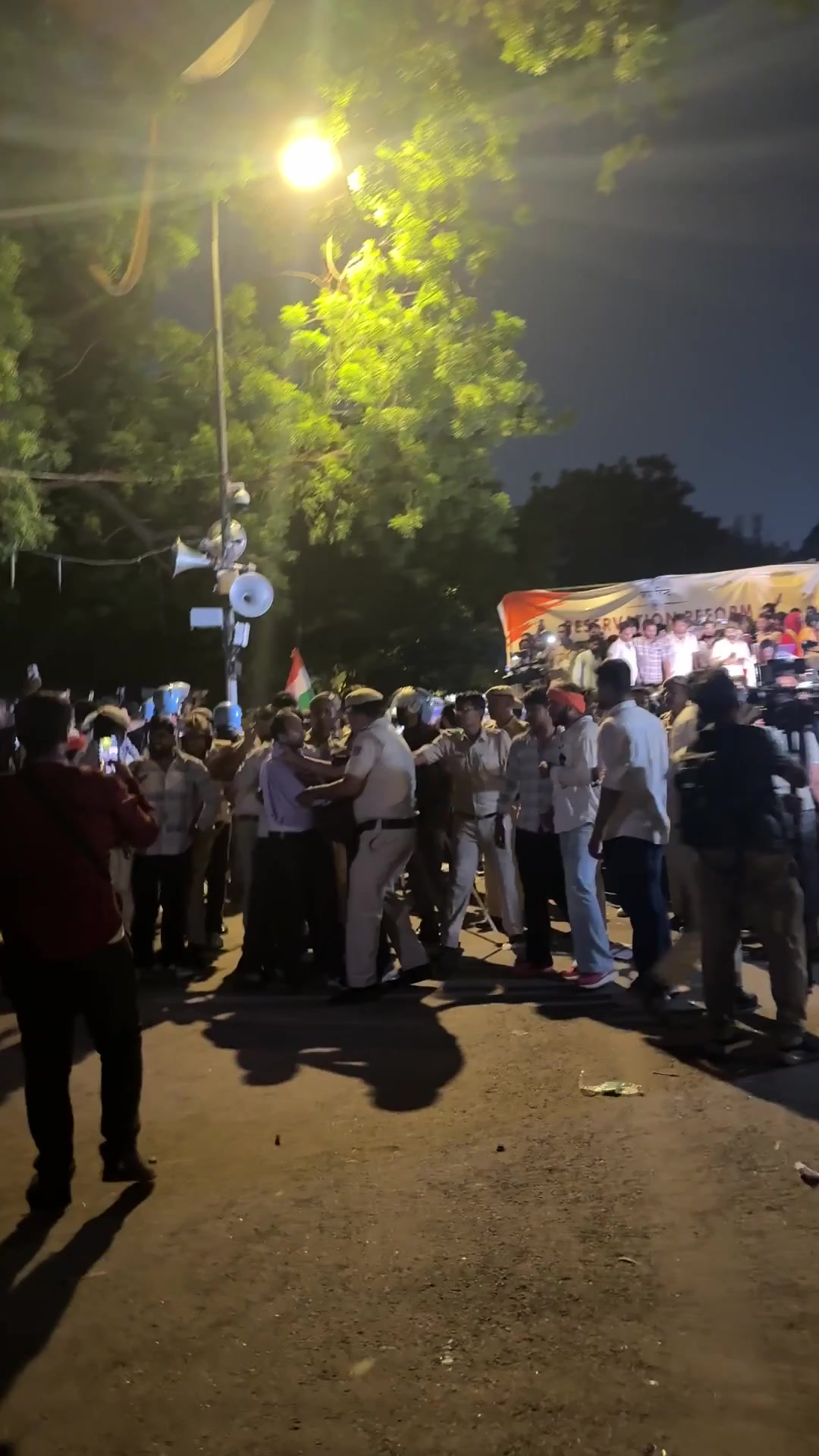
A large crowd gathered at Delhi's Jantar Mantar on August 21 for the Reservation Hatao Andolan. The mobilisation raised demands concerning reservation reform, UGC equity regulations and the SC/ST (Prevention of Atrocities) Act. But the day's most consequential question was administrative: how did a protest that Delhi Police publicly said had no permission at Jantar Mantar nevertheless continue at that location?
The question behind the protest
The organisers had formally sought permission for a demonstration at Jantar Mantar. Police acknowledged the communication, but the acknowledgement itself said it should not be construed as permission.
On August 20, Delhi Police publicly said that no permission had been granted for any protest, procession, demonstration or assembly at Jantar Mantar. The police also referred to prohibitory orders under Section 163 of the Bharatiya Nagarik Suraksha Sanhita.
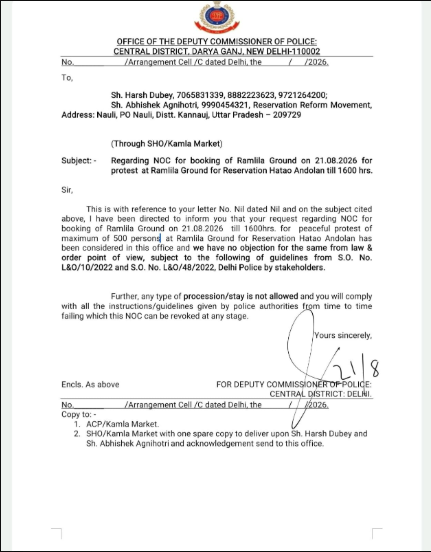
The authorities then provided an alternative venue: Ramlila Ground, with an NOC for a peaceful gathering of up to 500 people until 4 p.m.
Despite that position, protesters remained at Jantar Mantar. At 3:50 p.m., an organiser-linked General Janta Party account posted that “Permission” had been obtained and that the stage was being prepared. Later, India Today reported that permission was granted for the demonstration at Jantar Mantar after hours of discussions.
What changed between the police's “no permission” position and the reported later approval?
SOCHORA has not independently obtained the official document reportedly granting that later permission. That missing document—and the communication trail surrounding it—is therefore central to this investigation.
The evidence timeline
Organisers formally approach police
The supplied application seeks permission for the August 21 demonstration at Jantar Mantar. The acknowledgement does not itself constitute permission.
Delhi Police says no permission
The police public notice calls claims of Jantar Mantar permission “false and misleading” and says no permission had been granted.
Ramlila Ground NOC
The DCP Central District document records no objection to a peaceful gathering of up to 500 people at Ramlila Ground until 4 p.m., subject to conditions.
Organiser-linked account claims permission
The General Janta Party post says “Permission” and shows the protest continuing at Jantar Mantar. This is an organiser-side claim, not the original official permission document.
Later Jantar Mantar approval
India Today reported that permission was later granted for the demonstration at Jantar Mantar. SOCHORA has not independently obtained the underlying official document.
The organisers' application
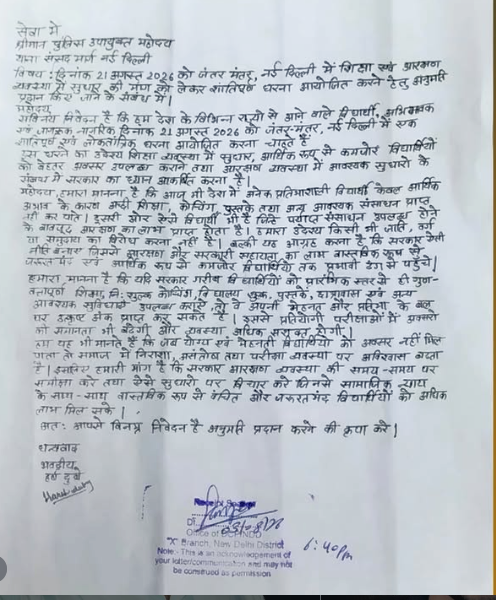
What it establishes: the organisers formally approached the authorities. What it does not establish: the acknowledgement itself was permission.
Delhi Police: “No permission”
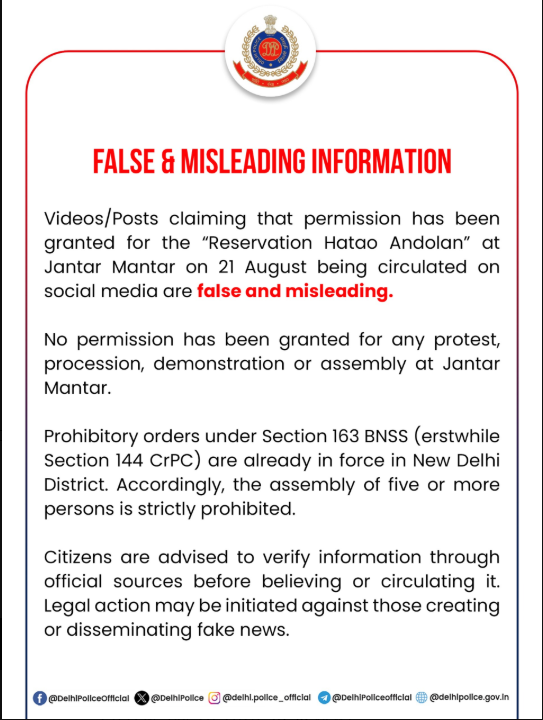
The supplied Delhi Police notice states that no permission had been granted for any protest, procession, demonstration or assembly at Jantar Mantar and describes contrary claims as “false and misleading.”
Ramlila Ground NOC
3:50 PM: “Permission”
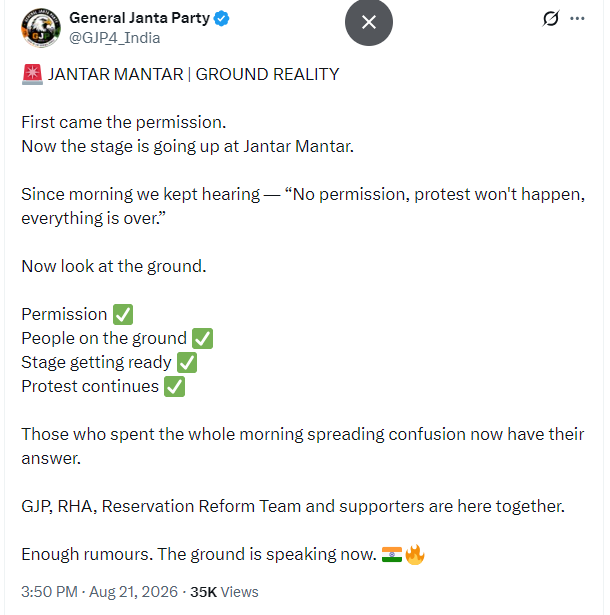
Status: organiser-side claim. SOCHORA has not independently obtained the official permission document referred to by the post.
Was the permission process properly managed?
The issue is not whether protesters automatically have an unrestricted right to use their preferred venue. Public assemblies can be subject to lawful restrictions concerning public order, safety, traffic and security.
The investigative question is narrower: was the application handled in a timely, transparent and procedurally consistent manner?
If Jantar Mantar was not going to be permitted, when was that decision made? When was it communicated? Why was Ramlila Ground offered? How was the 500-person limit determined? And if the Jantar Mantar position later changed, what caused the change?
The missing record
The most important document still not in SOCHORA's possession is the official communication, if any, that granted or otherwise authorised the later Jantar Mantar demonstration. The complete exchange between organisers and police is also needed to reconstruct the decision-making process.
What were protesters demanding?
The August 21 mobilisation was broader than opposition to reservation alone. Protesters demanded reforms to the reservation system, including greater emphasis on economic circumstances and the targeting of benefits towards people they consider genuinely disadvantaged.
They also raised objections to the UGC (Promotion of Equity in Higher Education Institutions) Regulations, 2026. India Today reported that protesters opposed the now-stayed UGC norms and that the issue was among the central themes of the mobilisation.
Protesters also raised concerns about the Scheduled Castes and Scheduled Tribes (Prevention of Atrocities) Act, 1989, including allegations of misuse. Some participants described provisions as “draconian”; SOCHORA uses that description only as an attributed protester position, not as an independent legal finding.
What RHA says it wants
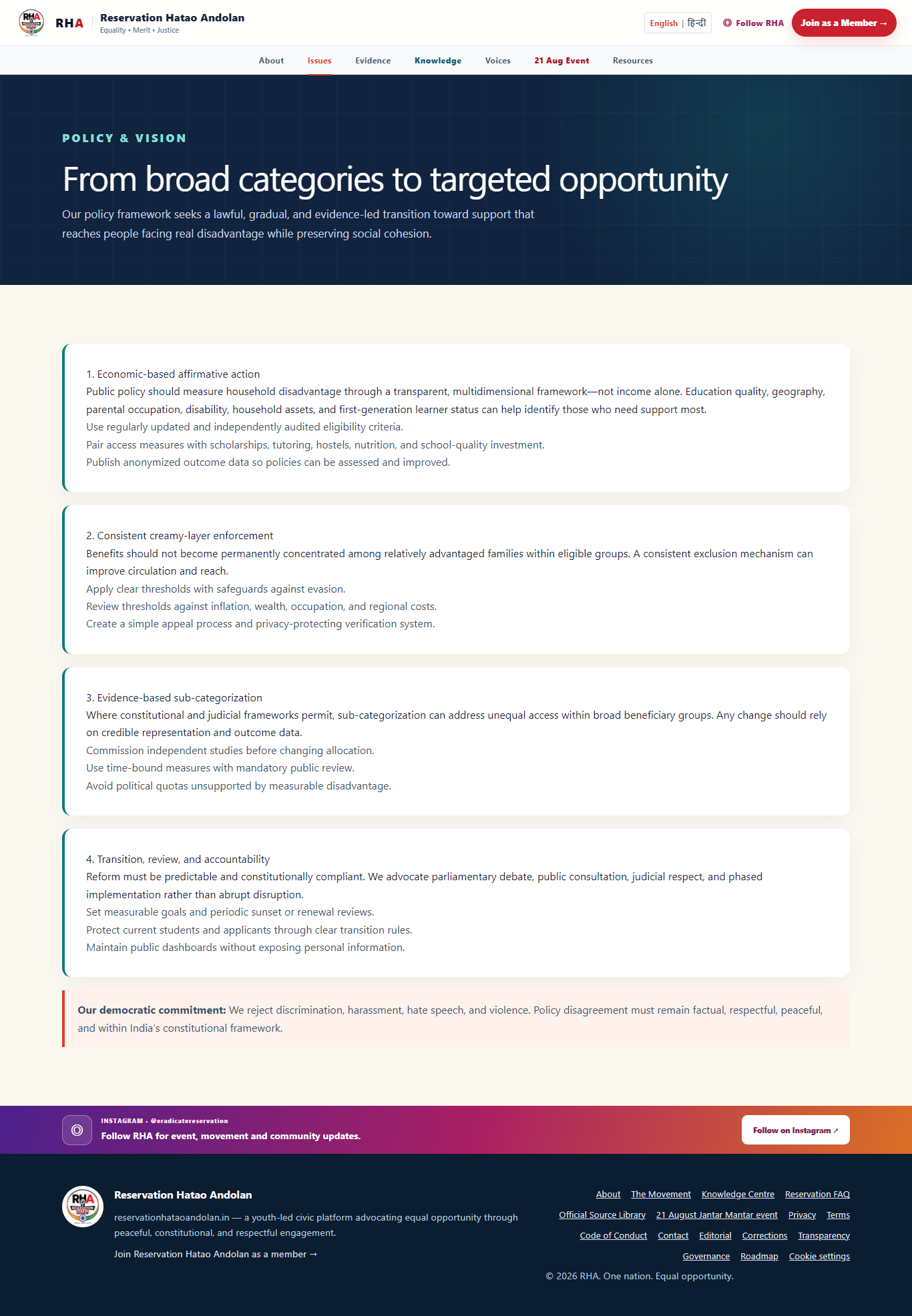
RHA's published policy page describes a “lawful, gradual, and evidence-led transition” and outlines economic-based affirmative action, creamy-layer enforcement, evidence-based sub-categorisation and phased reform.
Police action and the nighttime footage
Multiple news reports said several protesters were detained at Jantar Mantar as police and Rapid Action Force personnel managed the gathering. The supplied footage provides additional visual material, but it must be read carefully.
Police presence and physical escorting
What the footage shows: police personnel in protective equipment, officers carrying lathis and individuals being physically escorted or held during the nighttime gathering. What it does not clearly show: an officer striking a protester with a lathi. SOCHORA therefore does not describe this video alone as conclusive proof of a lathi charge.
An injured protester receiving treatment
What the footage establishes: a visibly injured man receiving treatment, including dressings around the head and arms. What it does not establish: how the injuries occurred or whether police caused them.
What SOCHORA has established
| Finding | Status |
|---|---|
| Organisers submitted a Jantar Mantar application | Documented |
| Police acknowledgement said it was not permission | Documented |
| Delhi Police publicly denied Jantar Mantar permission before the protest | Official statement |
| Ramlila Ground NOC issued for up to 500 people until 4 PM | Documented |
| Large crowd gathered at Jantar Mantar | Reported |
| GJP account claimed permission at 3:50 PM | Organiser claim |
| Later Jantar Mantar permission | Reported; original document not obtained |
| Protesters were detained | Independently reported |
| Police carrying lathis visible in supplied video | Visual evidence |
| Lathi charge clearly established by supplied footage | Not established |
| Injured person receiving treatment visible | Visual evidence |
| Police caused the injury | Not established |
What remains unanswered
- When exactly was the decision on the Jantar Mantar application made?
- What communications passed between the organisers and Delhi Police after the acknowledgement?
- Why was Ramlila Ground selected as the alternative venue?
- What was the basis for the 500-person limit?
- When and under what conditions was the later Jantar Mantar approval reportedly granted?
- How many protesters were detained, and under which legal provisions?
- What happened to the injured protesters, and what do medical records show?
- Was force used during the nighttime operation, and if so, under what circumstances?
SOCHORA seeks answers
SOCHORA invites Delhi Police and the protest organisers to provide documentary clarification regarding the permission sequence, venue change, detentions and nighttime events.
Questions for Delhi Police
- What was the final decision on the original Jantar Mantar application?
- When was that decision communicated?
- Why was Ramlila Ground offered and how was the 500-person limit determined?
- Was Jantar Mantar subsequently authorised? If so, when and under what conditions?
- How many protesters were detained and under what provisions?
- What is the police account of the nighttime action and reported injuries?
Questions for organisers
- What communication did organisers rely upon when claiming Jantar Mantar permission?
- When did organisers learn of the police position that Jantar Mantar had not been authorised?
- What is the organisers' account of the detentions and nighttime events?
Responses received after publication will be added to this report and clearly identified.
Jantar Mantar: from astronomy to public protest
Jantar Mantar in Delhi was constructed in 1724 by Maharaja Sawai Jai Singh II of Jaipur as an astronomical observatory. Nearly three centuries later, the historic site has also become a recognised location for public demonstrations.
Conclusion
The Reservation Hatao Andolan brought a contentious national debate into the streets of New Delhi. Its supporters raised demands concerning reservation reform, UGC equity regulations and the operation of the SC/ST Act.
But the events at Jantar Mantar also produced an institutional question. The documentary record reviewed by SOCHORA shows an application for Jantar Mantar, an acknowledgement that expressly did not constitute permission, a public police statement denying permission, an alternative NOC for Ramlila Ground, and a large gathering at Jantar Mantar. An organiser-linked group later claimed permission, while India Today reported that permission was subsequently granted.
That sequence does not, on the evidence currently available to SOCHORA, establish deliberate police misconduct or an intention to derail the protest.
It does justify asking: when did the position change, why did it change, who made the decision, and how was it communicated?
Those questions should be answered through documents, official records, eyewitness evidence and transparent responses—not assumptions from either side.
Report what is established.
Attribute what is claimed.
Question what remains unexplained.
Related context supplied to SOCHORA — not evidence of the August 21 permission dispute
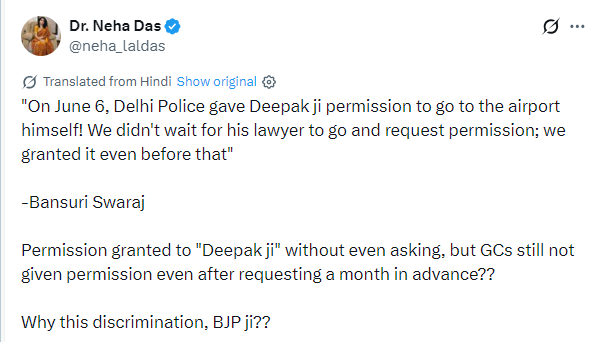
This separate social-media post concerns a different June 6 permission allegation and is not used by SOCHORA as evidence that Delhi Police mishandled the August 21 Jantar Mantar application. It is retained here for transparency because it was supplied during the reporting process.